

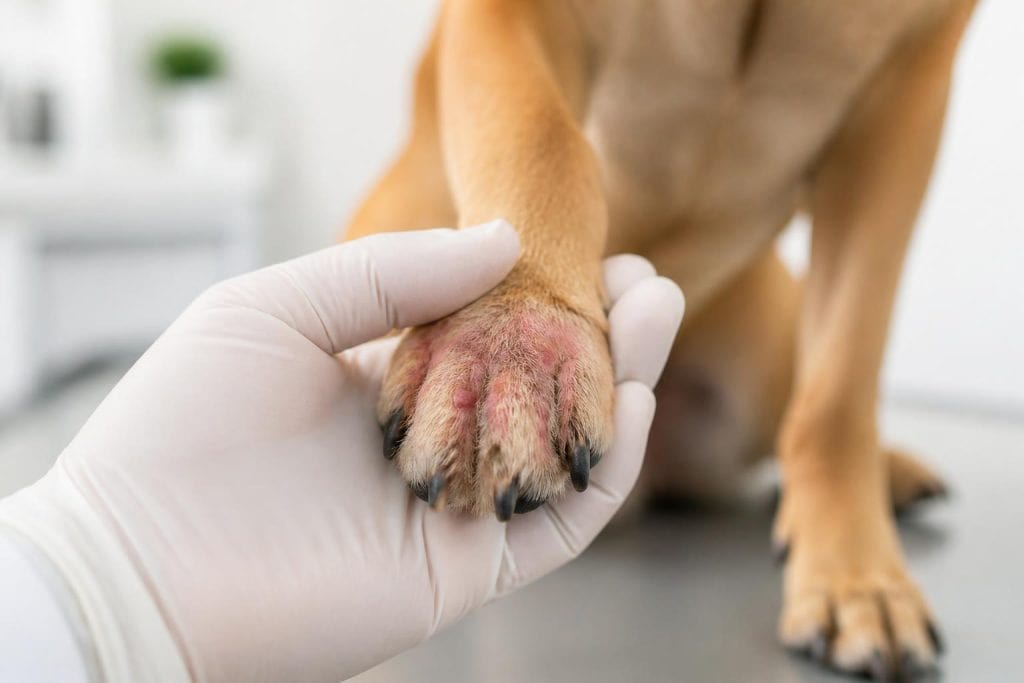
A furuncle often appears as a lump between one or more of the dog's toes, sometimes with an opening or sore on the surface. Furunculosis is a form of pododermatitis, which is inflammation of the skin of the paw, and is difficult to treat once it has occurred. Therefore, it is important to seek care early.
Why do dogs get furunculosis?
If the skin on the paw becomes inflamed, for example due to allergy, it swells and turns red. When the skin swells, it can start rubbing against itself, which causes the fur to wear away and the skin to thicken. This can lead to clogged pores in the skin.
Sebum is produced in the pores and skin cells are shed. Since the contents cannot be emptied normally, they accumulate inside the skin and form an increasingly large change, which can resemble a lump between the toes. Eventually, it can burst and form a hole through the skin, a so-called fistula. The fistula's opening often forms on the top of the paw, where the skin is thinner. The problem may therefore have started on the underside of the paw, even if the wound is visible on the top.
As long as the lesion is closed, it is usually sterile, meaning that bacteria do not need to be involved. However, when it ruptures, an opening in the skin is created where bacteria can enter, which can lead to a secondary infection.
How to investigate furunculosis in dogs
If you suspect your dog has a boil, it is important to make an appointment with your veterinarian. In order to treat the problem properly, the veterinarian will need to try to find both the cause of the boil and the factors that are preventing it from healing. During the examination, the veterinarian will look at, among other things:
- The underlying cause. Boils are often caused by some form of allergy or other inflammation of the skin. The problem can also be linked to incorrect loading of the paw, for example due to pain from bones or joints. In such cases, the dog may need to be further examined by an orthopedist.
- Secondary infection. Once a boil has opened, bacteria or yeast can more easily enter the skin. The vet may therefore need to take samples to check for an infection. If an infection is found, it may need to be treated with, for example, antibacterial or antifungal shampoo or other treatment.
- Factors that aggravate the problem and prevent healing. Certain things increase the strain on the paws and make boils occur or become more difficult to heal. Overweight can, for example, increase pressure and friction against the paws.
It is important to find and treat the underlying cause. Treating the boil itself alone is often not enough to prevent the problem from coming back.
Treatment of furunculosis in dogs
Once boils have formed, they are very difficult to treat. Therefore, it is important to seek medical attention as early as possible. Small boils can be controlled for a long time with topical treatment, but large boils that cause pain and discomfort should be treated with surgery.
Laser treatment
The most effective treatment for furunculosis is laser treatment. The inflamed skin on the paw is removed with a laser, layer by layer, until healthy tissue is reached. Furuncles can also be surgically removed with a scalpel, but laser has several advantages: the surrounding tissue is less damaged, bleeding is limited and the nerve fibers are sealed, which usually causes less pain afterwards.
Most dogs improve significantly after treatment, but sometimes more than one treatment is required. How many are needed depends primarily on how extensive the furunculosis is. The cost is approximately SEK 25,000–50,000 per treatment, depending on how extensive the changes are.
Aftercare after laser treatment
After the laser treatment, there will be relatively large open wounds on the paw that need to be bandaged. During the healing process, the paws may become oozy, smelly, and more susceptible to bacterial growth. This is part of the wound healing process and can be managed with regular cleaning and bandage changes, which you can often get help with from your local vet. Complete healing takes about eight weeks.
The goal of treatment is to get the paws as good as possible and at the same time treat any underlying causes, so that the risk of new boils is reduced.
Does your dog have a lump or sore between his toes? We examine the paws at a home visit and takes samples if necessary. The earlier furunculosis is detected, the easier it is to treat.
Frequently asked questions about furunculosis in dogs
What causes furunculosis?
Most often due to allergies or other inflammation of the skin of the paw. The skin swells, rubs against itself and the pores become clogged, so that sebum and skin cells collect in a growing lump. Improper load due to pain from joints or bones, and excess weight, can contribute.
Should you squeeze or drain a boil yourself?
No. As long as the boil is closed, it is usually sterile. If it is opened, bacteria can enter and cause a secondary infection. Instead, make an appointment with your veterinarian so that the cause can be investigated and treatment adjusted.
Is there an ointment for furunculosis in dogs?
Small boils can sometimes be kept under control for a long time with topical treatment prescribed by your veterinarian. Large, painful boils, however, need to be treated with laser or surgery. If the boil has opened and become infected, antibacterial or antifungal shampoos may be needed.
How much does laser treatment of furunculosis cost?
Approximately 25,000–50,000 SEK per treatment, depending on how extensive the changes are. Sometimes more than one treatment is needed. Laser treatment is performed at selected Animal Hospitals.iorkoll via Vetathome today, so we can help give your furry friend a pain-free and cozy winter. (edited)


